
Fleet
Information about our fleet of locomotives
(other rolling stock details to follow).
No.1
(RH449753) "Largo Law" Manufacturer: Ruston and Hornsby Years of manufacture: 1960/1961 respectively Operator Number: 1 Specification: 165DE 0-4-0 This locomotive began it's life at Kincardine power station and then it moved to work for Scottish Power at Methil Power Station which was located just down the river Leven from our site This locomotive is currently undergoing restoration

No.2
(RH431764) "Garvie Flyer" Manufacturer: Ruston and Hornsby Years of manufacture: 1960/1961 respectively Operator Number: 2 Specification: 165DE 0-4-0 This locomotive began it's life at Kincardine power station and then it moved to work for Scottish Power at Methil Power Station which was located just down the river Leven from our site

No.3
BAC No.3 This locomotive is currently undergoing restoration

No.4
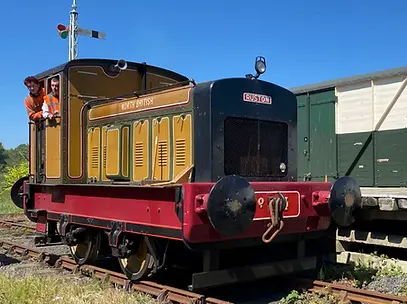
(RH421415) "North British" Manufacturer: Ruston and Hornsby Year of manufacture: 1955 North British Number: 4 Specifications: 88DS 0-4-0 This locomotive spent most of her working life at the North British Distillery in Edinburgh, conducting shunting duties. It came into preservation at Lochty Private Railway, and thereafter became part of the assets of KFRPS in 1992. Number 4 is operational and works as part of our Permanent Way stock. She can regularly be seen performing shunting duties prior to the commencement of Open Days.
No.7
(RH313390) "Big Ruston" Manufacturer: Ruston and Hornsby Year of manufacture: 1952 Specifications: 165DS 0-4-0DS The big sister at the yard to ‘North British’, Number 7 saw service at Rosyth Dockyard. She is fully operational and shares permanent way duties with ‘North British’.

No.10
National Coal Board - East Fife Area (NBL27591) "NBL" Operator Number: No.10 Year of manufacture: 1957 Specifications: 440DH 0-6-0 A truly unique locomotive. She served at several collieries (Michael, Wellesley, and Bowhill) before being taken out of service in 1974. She thereafter moved to Lochty Private Railway where she once again was put to good use. She is undergoing cosmetic restoration at the moment and is not operational, however there is a strong depth of feeling to return her to full operational use and we are currently fundraising to achieve this aim. If you would like to make a donation please click on this link: This locomotive is currently undergoing restoration

Forth
Wemyss Coal Company "Forth" Manufacturer: Andrew Barclay Manufacturer Number: 1890 SGB Number: 10 Specification: 0-4-0ST Year of Manufacture: 1926 "Forth" is an Andrew Barclay 14" cylinder design built in 1926 for the Scottish Gas Board and delivered to Granton Gas Works, Edinburgh. It served there until surplus to requirements, and in 1973 moved to Strathspey Railway. Seeing no use at Strathspey and in need of a cost-effective locomotive, it fell into the hands of Lochty Private Railway, finally being brought into steam once again in 1989. Due to the closure of Lochty Private Railway in 1992 it was once again laid up and in 1994 moved along with other stock into storage at Methil Power Station. As you will know from the History page, she moved to Kirkland with the other stock in 2003, and the long task of restoring and rebuilding began in earnest once Kirkland Yard was fit for purpose. Work on "Forth" finished in 2016 and she has been operational at Kirkland since then. Regular servicing and inspections have ensured annual steam pressure tests are passed. Currently the only operational steam loco at the FHR, Forth has a special place at Kirkland and is very popular with volunteers and visitors alike. 2026 sees the Centenary of Forth.

NCB No.21
National Coal Board No 21 The 'Dubbie Pug' Manufacturer: Andrew Barclay Manufacturer Number 2292 Specification: 0-4-0ST with 16” cylinders and extended wheelbase. Year of Manufacture: 1951. No 21 worked in Fife at the Nellie, Bowhill and Aitken collieries, in Stirlingshire at Manor Powis and at Kinneil in West Lothian. It returned to Fife and was the last steam locomotive working at the Frances colliery in Dysart, where it became known as the “Dubbie Pug”. (A “dub” is Scots for a puddle, and the Frances was near the local area called the “Dubbie Braes”. A “pug” was the common Scots name for a small locomotive.) On retiral it moved to Lochty and then eventually to Kirkland (see History page). It was restored cosmetically by Leven (1370) Air Training Corps, but deteriorated after sitting uncovered. It has been stripped down and restoration is proceeding slowly, so the prospect of a second working steam locomotive is still a long way off. Photo credit – Gerv Wright (taken 15.8.77)
%20Gerv%20Wright.png)
No.400
RAF "River Eden" Manufacturer: North British Locomotive Co. Glasgow Year of Manufacture: 1955 Number: 400 Weight: 32 tonnes Power: Diesel Hydraulic, 200bhp Top Speed: 14.5mph History: River Eden's primary claim to fame is having been built to the same technical specifications as a British Rail class 2/1. River Eden spent her entire working life at RAF Leuchars, shunting ammunition and provision wagons. Upon retirement she was sold to Lochty Private Railway where she undertook similar shunting duties as well as pulling the occasional passenger train. When Lochty closed in 1992, River Eden was placed into storage at Methil Power Station until 2001 when she made the move to Kirkland. Thankfully she had been mechanically maintained but required thorough cosmetic reconstruction to bring her back to full life. After this work was completed the Base Commander of RAF Leuchars very kindly attended the Yard and participated in the re-naming ceremony for her. Since 2001 River Eden has been the backbone of Kirkland - taking everything thrown at her in her stride and until Forth's reconstruction in 2016 - she had the sole responsibility for all our passenger trains on Open Days. Nowadays she has a separate starring role in Open Days. Not only is she usually responsible for pre-opening shunting duties she also becomes a star attraction come 11.00 am and transforms herself into our "Driver for a Fiver" vehicle where you yes YOU can take full control for a journey up and down her custom track

52029
BR Class 107 DMU This unit is currently undergoing restoration. The British Rail Class 107 diesel multiple units (DMU) were built by the Derby Works of British Railways and were introduced in 1960. They were built initially for suburban workings on the south side of Glasgow and the Class remained in BR's Scottish Region for its service life. When new, a number were used on Dundee/Arbroath services. In later years, they were used almost exclusively on services radiating from Glasgow Central to such destinations as Barrhead, East Kilbride, and Kilmacolm, and - prior to electrification - on Glasgow/Ayrshire services (especially Largs). Most were withdrawn from service by 1991. The back story of our DMU can be found here: http://preserved.railcar.co.uk/52029.html

313121
BR Class 313 EMU (test vehicle for the European Rail Traffic Management System (ERTMS). The British Rail Class 313 is a class of dual-voltage electric multiple units (EMU) suburban and regional passenger trains. Built by British Rail Engineering Limited at Holgate Road carriage works between February 1976 and April 1977, they were the first production units that were derived from British Rail's 1971 prototype suburban EMU design which, as the BREL 1972 family, eventually encompassed 755 vehicles over five production classes (313, 314, 315, 507 and 508). They were the first second-generation EMUs to be constructed for British Rail and the first British Rail units with both a pantograph for 25 kV 50 Hz AC overhead lines and contact shoe equipment for 750 V DC third rail supply. They were, additionally, the first units in Britain to employ multi-function automatic Tightlock couplers, which include electrical and pneumatic connections allowing the coupling and uncoupling of units to be performed unassisted by the driver whilst in the cab. The Class 313 units were the oldest EMUs operating on the National Rail network in Great Britain prior to their withdrawal in 2023, having entered service in 1976. Background Two new fleets were ordered as part of the electrification, authorised in 1971, of suburban services on British Rail's Great Northern route between London King's Cross and Royston, via Welwyn Garden City on the East Coast Main Line and via Hertford North on the Hertford Loop Line. For outer-suburban services – those making limited stops over the length of the route – a fleet of 49 Class 312 units were procured as derivatives of the proven Class 310 design. The Class 313 fleet was correspondingly ordered for the inner-suburban services – those making frequent stops between London and Welwyn or Hertford. An integral component of the electrification programme was BR's acquisition from London Underground of the Northern City Line, which had been built at a size sufficient for mainline trains and which provided the most direct route between Finsbury Park, on the existing Great Northern route, and Moorgate in the City of London. Following completion of the electrification to Welwyn and Hertford, the London terminal for all inner-suburban services would switch from King's Cross to Moorgate, reducing the number of train movements at the former station enough to permit the remodelling and subsequent electrification of the complicated approach tracks. The Northern City Line tunnels, however, were still not large enough to be fitted with the same 25 kV 50 Hz AC overhead line electrification system used for the rest of programme, and were instead configured to use the 750 V DC third rail system standard on BR's Southern Region. This in turn required that a new design of EMU be developed for the Class 313 order, as none capable of running on both systems existed at the time. Given this requirement, the opportunity was taken to further develop the Class 445 and 446 prototypes that had been produced by British Rail Engineering Limited in 1971, and which were considered by BR to be "the basis of all [its] future suburban stock". As these prototypes had been configured for use only on third-rail electrification, a new intermediate trailer carrying a pantograph and AC to DC transformer was built and inserted into the two-car Class 446 prototype, which was then tested on AC-electrified track for six months in 1975. This three-car arrangement, with driving-motor vehicles 'sandwiching' the trailer carrying the AC collection equipment, was subsequently adopted as the basic layout for the Class 313 design. Description Given the need to use the Northern City Line tunnels, Class 313 units were built to a slightly smaller loading gauge than conventional trains. They were of standard length and width, but the roof was lower, which was most noticeable due to the lack of a "well" for the Stone Faiveley AMBR pantograph on the centre coach. They had to comply with regulations for underground trains, such as having doors at each end of the train for evacuation onto the tracks, and when on 750 V DC supply the traction supply for each motor coach was separate, whereas on conventional 750 V DC trains each coach in a unit is linked by a 750 V bus line. Due to this, each motor coach had shoe gear on both bogies, whereas normally it would only be on the leading bogie. They were fitted with trip-cocks that are struck by a raised train-stop arm at red signals and will apply the brakes if the train passes one. The units were originally numbered 313001–313064. Each unit was formed of two outer driving motors and an intermediate trailer with a pantograph. This was a reversal of the practice started in the 1960s, where the motors and pantograph were on an intermediate vehicle, with the outer vehicles being driving trailers. Part of the reason was to simplify the equipment to allow dual-voltage operation, and to keep down weight by spreading the heavy transformer and motors between vehicles. The intermediate trailer carried the pantograph and a transformer and rectifier, which on 25 kV AC provides 750 V DC to the motor coaches, each of which had four 110 horsepower (82 kW) GEC G310AZ direct current traction motors, two per bogie. On 750 V DC each motor coach drew its supply directly through its shoe gear. The traction motors were driven by a camshaft-controlled resistance system with series and parallel motor groupings and weak field steps. Originally the heating in the motor coaches was provided by passing air over the hot traction and braking resistors in addition to conventional heaters, but this feature was later taken out of use and the pneumatic dampers were disabled. Great Northern and Southern retrofitted their units with cab air conditioning. 313s had rheostatic braking (which was disabled on London Overground) in addition to conventional three-step air-operated disc braking. During braking if wheel slide was detected by the Wheel Slide Protection (WSP), rheostatic braking was disabled and disc-braking only was used. Great Northern units had sanding equipment. Unlike some other DMU/EMU classes, additional brake force was not available when the emergency brake application was initiated and was the equivalent force of a step 3/full service application. WSP was still active when making an emergency application. In addition to the primary suspension of rubber chevron spring and oil dampers, secondary suspension was provided by two air bellows per bogie - flow into each bellows was controlled independently by a levelling valve and arm assembly that allowed the suspension to inflate/deflate when the weight of the coach was increased or decreased by passenger loading. The air suspension was linked to the braking system via a Variable Load Valve (VLV), which increased air brake pressure when the coach was more heavily loaded to compensate for the additional weight. All units had standard class seating only. Following the privatisation of British Rail, ownership of the Class 313 fleet passed to leasing company Eversholt Rail Group. In June 2012 Eversholt sold twenty units (313121 and the nineteen 313/2 units) to newly formed lessor Beacon Rail. Network Rail leased Beacon Rail-owned unit 313121 as a test vehicle for the European Rail Traffic Management System (ERTMS) installation on the Hertford Loop. The unit was repainted into Network Rail's yellow house colours and internally refurbished at Alstom's Wembley Intercity Depot, to include a new driving desk, technician's workstation, kitchen and toilet facilities, and the necessary ERTMS equipment. The work was completed in June 2013 and the unit was tested for the first time on Friday 5 July 2013 between Wembley and Bletchley. It commenced testing on the Hertford Loop later that month. Following conclusion of the Hertford Loop works, it was placed in store at Eastleigh Works in May 2018. It was expected to be used again when ERTMS was ready for testing on the Great Western Main Line, but Network Rail instead listed the unit for sale by tender in January 2023. 313121 arrived at the Fife Heritage Railway in Leven Fife in August 2023. British Rail Class 313 – Technical Data In service1976–2023 ManufacturerBritish Rail Engineering Limited Built atHolgate Road Works, York Constructed1976–1977 Scrapped2019, 2023 Number built64 Number preserved2 Number scrapped62 Formation - 3 cars per unit: DMSO-PTSO-BDMSO Capacity as built: 232 seats Specifications Car body constructionSteel underframe with aluminium body and roof Car length: DM vehs.: 19.800 m (64 ft 11.5 in); Trailers: 19.920 m (65 ft 4.3 in) Width2.820 m (9 ft 3.0 in) Height3.582 m (11 ft 9.0 in) Floor height1.146 m (3 ft 9.1 in) DoorsDouble-leaf pocket sliding, each 1.288 m (4 ft 2.7 in) wide (2 per side per car) Wheel diameter840 mm (33 in) new WheelbaseOver bogie centres: 14.170 m (46 ft 5.9 in) Maximum speed75 mph (120 km/h) Weight DMSO vehs.: 35.87 t (35.30 LT; 39.54 ST) PTSO vehs.: 31.28 t (30.79 LT; 34.48 ST) BDMSO vehs.: 37.55 t (36.96 LT; 41.39 ST) Total: 104.70 t (103.05 LT; 115.41 ST) Traction motors 8 × GEC G310AZ (82 kW (110 hp) each, 4 per motor car) Power output 656 kW (880 hp) Tractive effort 90.7 kN (20,400 lbf) starting Acceleration0.79 m/s2 (2.6 ft/s2) Deceleration0.92 m/s2 (3.0 ft/s2) Electric system(s) 25 kV 50 Hz AC overhead plus 750 V DC third rail Current collection Pantograph (AC) plus Contact shoe (DC) UIC classificationBo′Bo′+2′2′+Bo′Bo′ BogiesBREL BX1 Minimum turning radius70.4 m (231 ft 0 in) Braking system(s)Electro-pneumatic (disc) and rheostatic ('Westcode' three-step) Safety system(s)AWS, TPWS, Tripcock (NCL units only) Coupling systemTightlock Multiple workingWithin class Track gauge1,435 mm (4 ft 8+1⁄2 in) standard gauge Specifications as of August 1982 except where otherwise noted. (from Wikipedia) This unit is currently undergoing restoration
